 |
Basket
0 items, £ 0.00

Why Digital Row Counters Are My Favourite Knitting Gadget
Digital row counters keep your knitting rhythm flowing, save time, prevent mistakes, and remove the faff of pens, paper, tally charts and needle‑end counters. After years of knitting, they’ve become my favourite gadget, and in this article I’ll explain exactly why.
 This article contains a sponsored link to Crazypatterns.
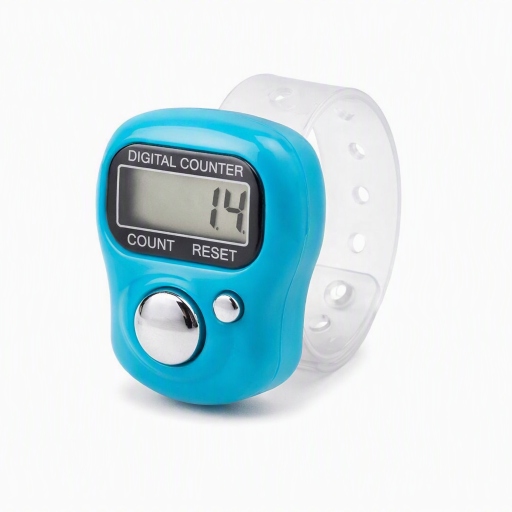
Digital row counters are small, inexpensive gadgets that sit on your finger and let you record rows with a simple thumb‑press. They speed up your knitting, keep your flow going, and remove the interruptions caused by older row‑counting methods. Once you get used to wearing one, it becomes second nature.
BDRC: Before Digital Row Counters
Before digital row counters existed, knitters relied on two main methods:
pencil and paper tally charts
the three‑dial row counter that sat on the end of your needle
Both worked, but both interrupted the rhythm of knitting.
With pencil and paper, you had to stop, put your work down, find the pen, make a mark, and then pick everything back up again. It doesn’t sound like much, but when you’re shaping, working lace, or following a detailed pattern, those constant interruptions break your concentration.
There was also the problem of scraps of paper. Knitters are notorious for grabbing whatever is nearby: envelopes, receipts, the back of a pattern, a corner of a notebook. You end up with little tally charts scattered everywhere, and half the time you can’t remember which one belongs to which project.
The needle‑end row counter was an improvement, but it still required you to stop and turn the dial. It was fiddly, and if you were using circular needles or interchangeable tips, it wasn’t always practical.
The problem with pens and paper
Pens and paper sound harmless, but they come with their own hazards.
If you keep a pen in your knitting bag, there’s always the risk it leaks onto your yarn. I’ve had this happen, and it’s heartbreaking when you’re working with pale or white yarn. Recently I was knitting in white and didn’t have a digital row counter with me, so I used the tally chart method. Some of the ink transferred onto my fingers and then onto the yarn. It left faint marks that I couldn’t remove, and it was incredibly frustrating.
There’s also the issue of pens going missing. Family members borrow them, they get left in other rooms, or they simply vanish. Pens grow legs. Digital row counters don’t.
How digital row counters work
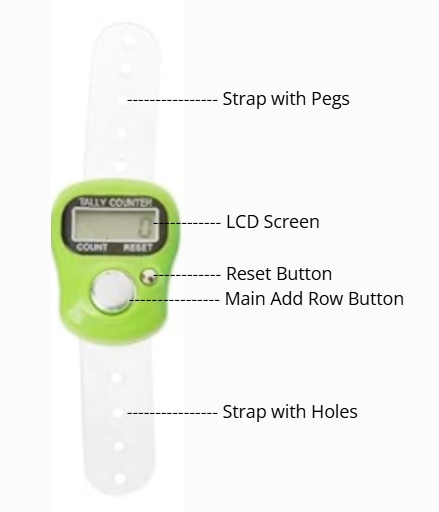
A digital row counter is a tiny gadget that straps onto your finger. Most have an adjustable strap with a peg‑and‑hole fastening, so one size fits most. I find the best place for mine is my left index finger. It feels strange at first, as anything new does, but after a short time you forget it’s there. I’ve even gone to leave the house still wearing mine.
The beauty of the digital row counter is that you don’t have to stop knitting. Your thumb simply reaches across and presses the button. That’s it. No putting your work down, no hunting for pens, no breaking your rhythm. The counter increments instantly, and you carry on knitting.
They’re also very cheap. Most cost only £2 or £3, which makes them one of the most affordable knitting tools you can buy.
Keeping your knitting flow going
Knitting has a natural rhythm. Once you’re in it, your hands move without thinking. Anything that interrupts that rhythm slows you down and increases the chance of mistakes.
Digital row counters keep you in the flow. You don’t have to pause, reposition your hands, or break concentration. You simply press the button and continue. Over the course of a project, this saves a surprising amount of time.
I tend to click on my wrong‑side rows, and I click twice. It’s a habit that works for me, and the counter keeps perfect track without me having to think about it.
Using row counters for repeat patterns
Digital row counters aren’t just for counting rows. They’re also brilliant for repeat patterns.
If a pattern says “repeat rows 1–10 five times”, you don’t need to count every individual row. Instead, you count the number of repeats. Each time you finish the 10‑row sequence, you press the button. It’s much easier to track repeats than rows, especially when you’re working on something with shaping or colour work.
This method reduces mistakes and makes it easier to see where you are in the pattern at a glance.
Portability and practicality
Digital row counters are small, light, and easy to pop into your knitting bag. They don’t leak, they don’t smudge, and they don’t get borrowed by other people. The only risk is small children pressing the button repeatedly to see how high they can make the number go.
They’re also ideal for knitting groups, travel knitting, or any situation where you don’t want to carry extra stationery.
Why I love them
After years of knitting, I can say honestly that digital row counters are my favourite knitting gadget. They save time, speed up my work, keep my knitting flow going, and remove the faff of pens, paper, and needle‑end counters. They’re inexpensive, reliable, and once you get used to wearing one, you’ll wonder how you ever managed without it.
A great resource for digital patterns
Crazypatterns is a digital download website and a brilliant resource for knitting, crochet and sewing patterns. Have your digital row counter at the ready and explore the patterns here.
Video demonstration
I’ve embedded a video on this page showing exactly how I use digital row counters, how to strap them onto your finger, and how to use them for both row counting and repeat patterns.
Article by Suzy Cowper, knitting designer and entrepreneur at TeaCosyFolk.
Tags: knitting m