 |

A Knitters Guide to The Best Ways to Sew Knitted Arms Legs Tails and Long Thin Knitted Tubes
Skinny knitted tubes such as tea cosy arms legs and tails can be tricky to sew neatly. This guide shows simple ways to sew long thin knitted pieces with smooth seams and a tidy finish so your tea cosies look their very best.
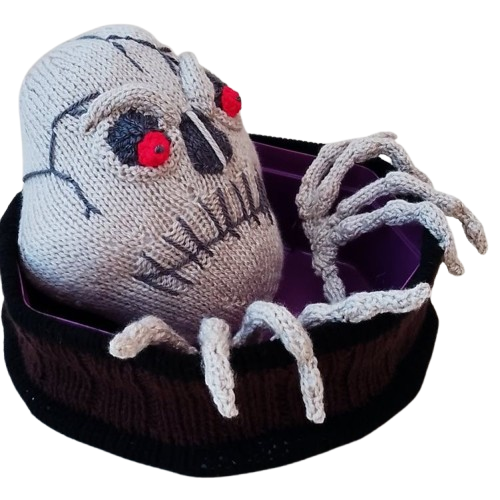 |
This picture shows the skeleton hand from the Halloween skull tea cosy which is made from long narrow knitted tubes just like the arms and legs in this guide. |
The Best Ways to Sew Knitted Arms Legs Tails and Long Thin Knitted Tubes
For most knitters the knitting itself is the easy part. It is the sewing up that causes the most problems. Narrow tubes such as knitted arms legs tails and other long thin pieces are the ones that knitters struggle with most. Many knitters are always looking for ways to achieve a neater more professional finish so this Cosy Companion is all about sewing up skinny knitted pieces with confidence.
Long thin shapes are awkward to sew especially if you were taught to put right sides together and use back stitch. When you try to back stitch a tiny tube such as toy legs toy arms or narrow tea cosy arms it can feel fiddly and frustrating. I find the easiest way to manage these slender pieces is to sew them in stages.
Right Sides Facing and Sew Up With Back Stitch
In the video below I am sewing up a slim arm that tapers at the wrist which makes it even narrower. I start by sewing the hand to the wrist and turning that section right side out first. That gets the trickiest part out of the way. The real magic is in the little tuck that lets you finish the rest of the arm neatly in back stitch.
This video shows how to sew up a narrow knitted arm using right sides together and back stitch. It demonstrates the method step by step so you can see how to manage the shaping and keep the seam neat on long thin knitted pieces.
Wrong Sides Facing and Sew Up With Mattress Stitch
For a truly professional finish my top recommendation for sewing up small knitted tubes is mattress stitch. Whether you are working on knitted tails knitted legs or long thin shapes such as walking sticks or goal posts mattress stitch brings the edges together beautifully. It looks clean polished and seamless. You do not have to turn the work and you can stuff the tube as you go.
You can also explore our guide on the best stitch for sewing up knitting which explains the strengths of each method and when to use them. What is the best stitch for sewing up knitting
This video shows how to sew up a skinny knitted tube using mattress stitch while rolling a sausage of stuffing and feeding it into the tube as you sew. This method keeps the shape smooth and even and gives a very neat professional finish.
This also solves the next problem. When you back stitch a skinny tube and then turn it the stuffing often bunches into lumps. This gives you the dreaded tennis balls in a sock effect. No one wants lumpy limbs.
Many knitters default to right sides together and back stitch because that is what older patterns taught. But mattress stitch is usually quicker as well as neater.
Forget Sewing Up and Say Hello to I Cords
Another excellent option is switching to an i cord. If your piece narrows to six stitches or fewer or if your toy animal tapers down to that point you can simply change to an i cord even if the pattern does not mention it. An i cord creates a smooth seamless knitted tube similar to French knitting.
Knitting an i cord is simple. You can do it on straight needles which works but feels like a bit of a faff or you can use double pointed needles which make the process much faster. On straight needles you knit across the stitches slip them back to the left needle and knit them again. You can increase or decrease as needed. The only slow part is the constant slipping back.
With double pointed needles you knit across slide the stitches to the other end and you are instantly ready for the next row. No slipping and no faffing.
A help video showing you how to knit I‑cords on straight needles and double pointed needles, including how to decrease within an I‑cord.
Both methods give you a seamless tube and the time you spend knitting the i cord is time saved on sewing up later. So if a pattern asks you to knit a skinny strip it is worth considering whether an i cord might give you a better cleaner result.
You can find a full step by step guide to sewing neat seams with mattress stitch in our photo tutorial for tea cosies.
With a few simple techniques skinny knitted tubes become much easier to manage and the results look cleaner and more polished. Whether you choose back stitch mattress stitch or switch to an i cord these methods will help your tea cosies and character pieces look neat confident and full of personality.
Tags: knitting help