 |

Can AI Design a Knitting Pattern?
Curious whether AI can design a knitting pattern? This article explores what AI gets right, what it gets wrong, and why human designers are still essential.
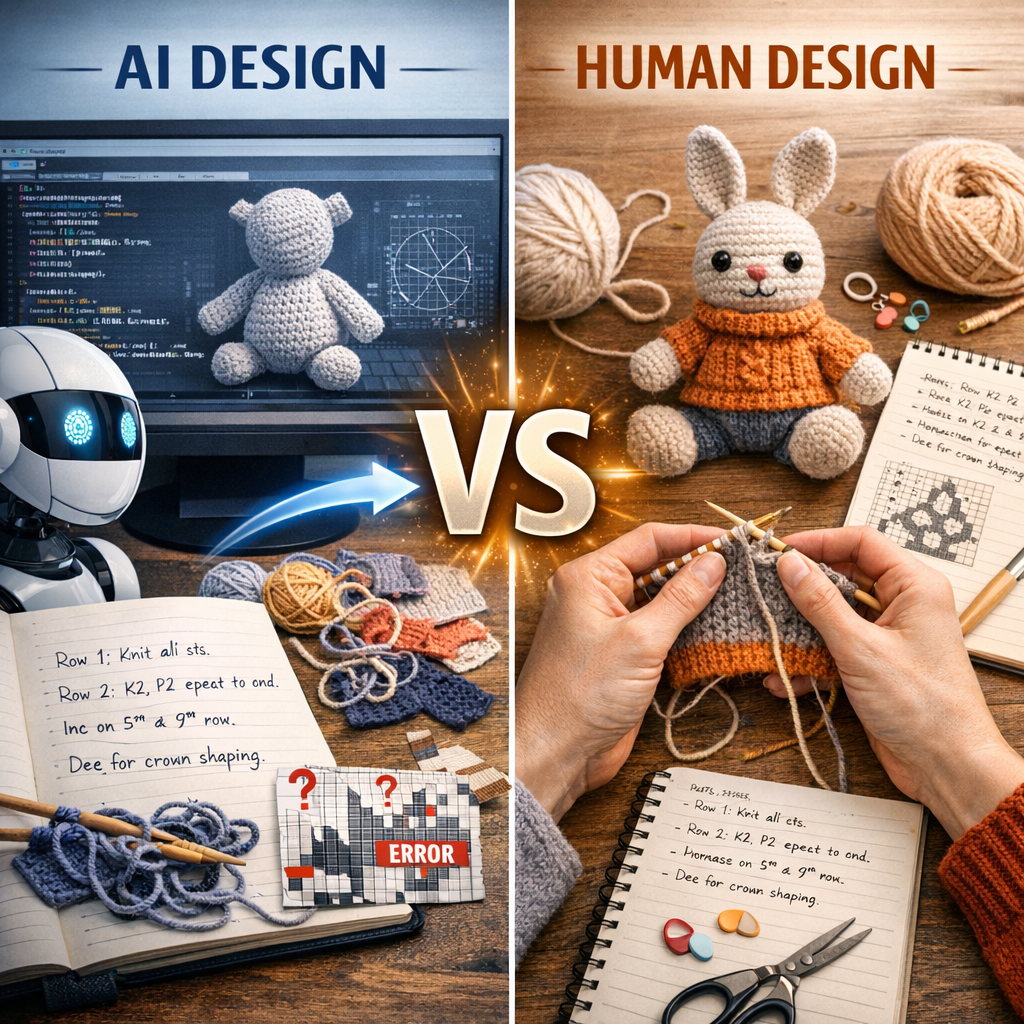
AI tools are becoming more visible in the crafting world, and many knitters are wondering whether artificial intelligence can actually design a knitting pattern. The short answer is that AI can help with ideas and early-stage creativity, but it cannot yet replace the skill, experience and technical understanding of a human knitting designer.
What AI Can Do Well
AI is excellent at supporting the early parts of the creative process. It can help you brainstorm themes, explore character ideas, and even sketch out visual concepts. It can also assist with writing tasks such as editing, formatting and explaining techniques in plain language. For inspiration and admin support, AI is a genuinely useful tool.
Some designers also use AI to organise their thoughts, tidy up rough notes, or help structure the written sections of a pattern. In these areas, AI acts as a helpful assistant rather than a designer.
Where AI Falls Short
Designing a real knitting pattern requires an understanding of how knitted fabric behaves in three dimensions. AI does not understand tension, shaping, stitch structure or construction. It cannot reliably calculate increases and decreases, maintain stitch counts, or ensure that shaping instructions match the intended form.
Even advanced tools often produce patterns with incorrect maths, impossible shaping or instructions that contradict themselves. AI cannot knit, test or visualise the physical outcome of its own instructions, which means it cannot take responsibility for the technical accuracy of a pattern.
Why Human Designers Are Still Essential
Knitting design is a craft built on experience. Designers know how stitches behave, how to shape curves and angles, how to create characters that stand upright, and how to write instructions that real knitters can follow. They understand the rhythm of a pattern, the flow of the rows and the subtle decisions that make a design enjoyable to knit.
AI can support the creative journey, but it cannot replace the intuition, technical skill and hands-on knowledge that human designers bring to their work. The designer’s eye, judgement and experience remain at the heart of every successful pattern.
The Role of AI Today
At its best, AI is a companion tool. It can help you explore ideas, tidy up text, and speed up some of the administrative parts of pattern writing. But the shaping, construction and technical design still come from the human designer. AI is clever, but it does not understand knitting in the way a knitter does.
Tags: AI pattern writing help